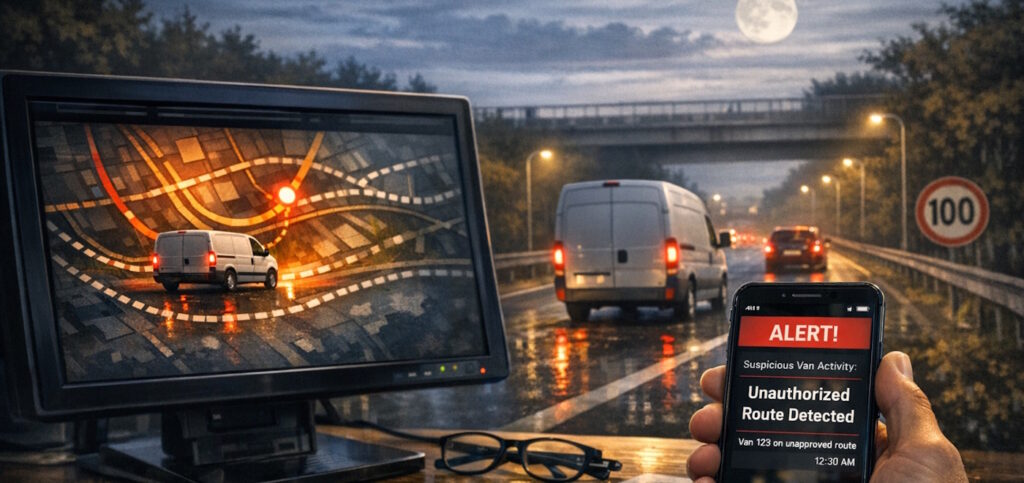
Picture a van on the motorway at 100 km/h, heading for the border, at half past midnight. Nothing about that is remarkable in itself, except that this particular van belongs to a regional service fleet that is always back in the depot by early evening and has never once left the district after dark. The data showing all of this was readily available. By the time anyone glanced at the tracking screen the next morning, the van was long gone.
That theft was detectable as it happened. So why did nobody catch it?
In my last piece, Why Agentic AI Hasn’t Taken Over the Dispatch Desk (Yet), I argued that agents will not be planning your tours any time soon, because dispatch decisions are physically irreversible and expensive to verify, and “let the agent run and check afterwards” falls apart the moment a real truck moves. I stand by that. But it leaves an obvious question hanging. If the whole problem is the commit, then what about the agents that commit nothing at all?
That is where the real near-term opportunity sits, and it is not glamorous. The agent that earns its place in your fleet first is the one that watches your operation, notices the thing that does not fit, and taps a human on the shoulder. No autonomy, no liability, no five-second verification problem. It turns an ocean of telematics data into the one message a human actually needed to see.
From Rules You Configure to Exceptions You Describe
Here is the uncomfortable thing about the stolen van: catching it was always possible. Every serious fleet management system can fire an alert when a vehicle leaves a geofence, moves outside business hours, or crosses a speed threshold. That capability has been shipping for more than twenty years.
The reason it rarely fires is that a human has to set it up. To catch that van, someone would have had to draw the geofence, define the operating window, set the speed band, decide which vehicles the rule applies to, and then maintain the whole thing as routes and vehicles change. Worse, they would have had to think of it in advance. The theft pattern you never imagined is precisely the one no rule covers.
This is the shift that makes agents interesting here. The old model asks you to enumerate, up front, every condition worth an alarm. The agentic model lets you describe intent in plain language, something close to “tell me when a vehicle is doing something it has never normally done”, and then reasons over the live stream to decide what qualifies. You stop maintaining a brittle ruleset for the exceptions you predicted, and you start getting flagged on the ones you did not. The value is the death of tedious configuration, not a grant of autonomy.
I saw both sides of this at Webfleet. The platform could do an enormous amount: geofences, maintenance alerts, driving-style scoring, custom reports. And a large share of customers used almost none of it. Not because they doubted the insight was worth having, but because setting it up was painful, and once it was set up it quietly went stale as reality moved on. The power was sitting right there, unused, because the effort to switch it on was higher than the daily pain of living without it.
What These Agents Actually Look Like
The clearest examples are read-only watchdogs. An anti-theft monitor that learns a vehicle’s normal week and flags the midnight run to the border. A fuel monitor that notices a drop in tank level with no trip to explain it and raises it as possible siphoning. An efficiency diagnostician that connects idling, driving style and vehicle data to tell you “this van is burning 10% more than it should, and here is the breakdown of why”, instead of leaving you to dig it out of a dashboard yourself. For electric fleets, a charge monitor that warns you in the evening that a vehicle which should be on a charger tonight is not plugged in, well before it becomes tomorrow morning’s failed tour.
None of these commit anything. They do not reroute, redispatch, or move money. They observe, and they escalate, and the human stays the decision-maker throughout. That single property is what makes them deployable today while the autonomous dispatcher is still not there anytime soon.
A second cluster touches paperwork rather than asphalt. An agent that chases unclassified trips and asks the driver “was the run to Client XYZ business or private?”. A receipt agent that reads a photographed receipt and reconciles it against the vehicle’s actual trip data before it reaches accounting. A license-check agent that runs the recurring compliance ritual on schedule so it stops being the task everyone forgets. The blast radius of a mistake here is an awkward email, not a collision. Same underlying logic, a little more action, still a long way from the dispatch desk.
Why This Is the On-Ramp, Not a Consolation Prize
It is tempting to read all of this as the boring version of the agentic dream, when it is actually how you get to the dream in the first place.
In the last piece I described autonomy as a ladder defined by liability exposure: low-exposure, reversible actions near the bottom, and decisions that burn a driver’s legal hours at the top. Monitoring agents sit below the bottom rung. Their exposure is zero, because they decide nothing. And that is exactly why they are the right place to begin. They are where an operation builds the one asset every later step depends on, which is a track record.
Every correct alert, every prevented theft, every caught charging miss is a piece of evidence that this agent understands how your fleet actually behaves. That evidence is the trust you will need before anyone sensibly lets an agent commit even a small, reversible action on its own. You cannot get it from a vendor demo. You earn it by letting the agent watch first, for months, while a human grades its judgment at no risk.
This is not a fringe view. Writing this month, Jonah McIntire, a well-known evangelist and CTO in the fleet space, presently at Trimble Transportation, makes a similar case from the enterprise-software side: that the binding constraint on enterprise AI agents is trust rather than raw capability. In his telling, you earn that trust through a catalogue of bounded, testable “skills”, each approved one expanding what the agent is allowed to own. That is the same ladder I am describing, viewed from the enterprise-software side. The difference in a fleet is that his framework is built to bound an agent that acts inside your systems. The monitoring agent sits one rung below even that, because it acts on nothing. It needs almost none of that trust machinery yet, which is exactly what makes it the sane place to begin, before you take on the harder engineering of letting an agent commit.
So the route into agentic AI is not a leap from zero to full autonomy. Deploy the agents that only watch. Let them prove themselves against real exceptions. Then climb the exposure ladder one rung at a time, as the track record earns it.
Where It Goes Wrong
The failure mode here is not the dramatic one from the dispatch world. It is quieter, and it is real: alert fatigue. A monitor that flags too much trains its humans to ignore it, and an ignored alert is worse than no alert at all, because it carries the false comfort that something is being watched.
So the design problem moves. The question is no longer “how do I verify a commit”, it becomes “what is genuinely worth a human’s attention”. Precision matters more than completeness. Ten sharp alerts a week that are nearly always right will get acted on. Two hundred noisy ones get filtered into a folder nobody opens. The hard and valuable work inside a monitoring agent is the judgment about what not to send.
The Practical Takeaway
If you run a fleet and you have been waiting for the autonomous-dispatch future before you touch agentic AI, you are waiting for the wrong thing. The version that pays off today sits one decision below autonomy: an agent that watches your operation, learns what normal looks like, and tells a human when something does not fit. It removes the configuration work nobody had time for, it catches the exception nobody wrote a rule for, and it commits nothing it could get wrong.
Start there. Earn the track record. Climb when it is justified.
There is a bigger question lurking underneath all of this: do these agents need to live inside your fleet management platform at all, or does the future belong to general-purpose agents that reach into your FMS through a connector (API or MCP) and treat it as just one tool among many? That question decides what an FMS vendor still owns in five years, and it deserves its own piece. I will get to it soon.
If you are working out where agentic AI realistically fits in your fleet operation, or building it into your product, this is exactly the kind of roadmap I help teams draw up. Feel free to reach out.