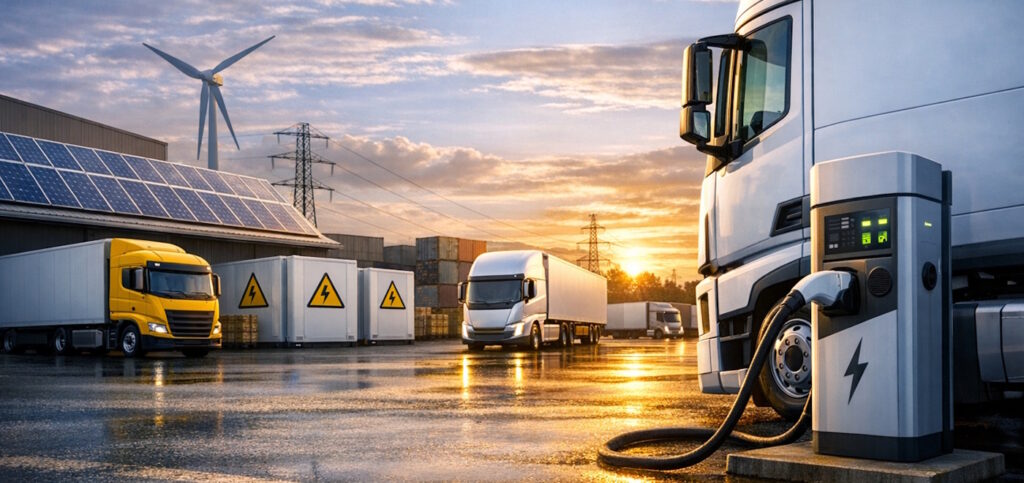
I visited an event last week, set up by the BVL with the topic of Energy meets Logistics – how logistics companies can earn money with energy and energy storage. The pitch was rather simple: logistics companies have a lot of space available for rooftop-solar, they have heavy machines which (if electrified) could earn some of their investment costs back via vehicle-to-grid models. What would be needed to actually realize this potential? It was a good session, well organized by the local BVL chapter.
In total, there were maybe 30-40 people there. When everybody was introducing themselves, it turned out two of those people were working in logistics companies. The rest were either working for service providers or just interested in the topic in general. Which, unfortunately, paints a rather sad but telling picture of our industry.
Then another announcement dropped this week: the German federal ministry of transport is giving out 1 billion Euro during the course of the next 4 years to support companies in building their charging infrastructure for heavy commercial vehicles.
The new program does not just fund chargers, it covers grid connection, battery storage and load management as well. And there is a dedicated track for small and mid-sized companies, with applications opening on 5 June 2026.
Two consecutive weeks, two very different experiences. And that made me wonder about the state of the logistics industry in Germany right now, and why fleet electrification is still not widely accepted.
The little devil on my shoulder has an easy answer: our industry is extremely conservative, things in Germany just take a bit longer, we saw it before with connected navigation, telematics control units, video telematics. But I think this is over-simplifying things.
Let’s try to put ourselves into the shoes of a small logistics company. You have maybe 5-10 trucks, a couple more drivers. You have been doing business with customers for a long time, often using long-term contracts. Due to the rising fuel prices, those contracts might have just blown up on you, if they don’t contain fuel-price clauses. Some do, some don’t. Common operating margins for businesses like this are somewhere between 1 and 5%. There is a high chance that those margins in the present situation are gone and you are driving straight into red numbers.
At a point in time like this, are you looking at getting an electric truck that still costs roughly twice as much as a diesel one? Do you have the mental capacity to worry about charging infrastructure and how to set things up at your depot? Would you look forward to discussing power connection capacity and costs for your depot with your energy provider? Or how to best combine solar power on your roof with a battery to keep your charging costs down?
All of those are important points. But they do need time and mental capacity, which I believe a lot of company owners in this space simply don’t have. In a relatively short time, this will become a problem, though. The reason is simple: others are leading the way.
Subsidies are part of the story. There was a time when up to 80% of the cost difference between an electric and a diesel truck could be covered by government grants. That window has narrowed, but it has not closed. The big federal KSNI program for charging infrastructure has run out, but the new 1 billion Euro program I mentioned at the top is on the way, and there are still state-level programs with similar scope, for example in Nordrhein-Westfalen.
There are companies out there using those kinds of subsidies to renew and electrify their fleet. And the cost-benefits are astonishing. You save the road toll right now. The energy you are using to drive the truck costs a fraction of the fuel-costs that the old-style competition is paying. Maintenance costs are way lower. And the higher upfront investment is grant-funded, at least in part.
In addition, in just a couple of years, those expensive electric trucks will be written off and the initially higher costs will be out of the books. At this point in time in the not so distant future, companies who did not make the switch will compete with fully electrified fleets. Costs per kilometer which are not even in the same ballpark.
What logistics companies have done extremely well for decades is to calculate total costs of ownership and costs per kilometer down to the penny. Which is exactly why the operators who actually do the math will switch first. They know that soon diesel-trucks will no longer be competitive, and you don’t even need to count on diesel prices going further up, which will happen anyway due to increased CO2-pricing and the upcoming ETS2 extension to road transport. And that does not even factor in geopolitical factors like what is going on in the Strait of Hormuz.
Fleet electrification and usage of self-produced renewable energy right now is one of the most promising ways for logistics players to reduce their running costs. Yet, a lot of companies lack the capacity to renew their fleets and go electric.
My take: there are a lot of good service providers out there who have become very good at taking all the pain away from you. There are subsidies available, there are financing options available. Maybe you cannot do the switch now. But if you don’t at least take the time to plan your transition, then when the next subsidy drops, you will once again be left behind.
And that brings me back to that BVL session. Two operators in a room of forty. The companies who send someone into that room over the next 12 months, even just to listen, will be the ones still making a margin in 2030. The rest will be acquisition targets in the best case, and gone in the worst.